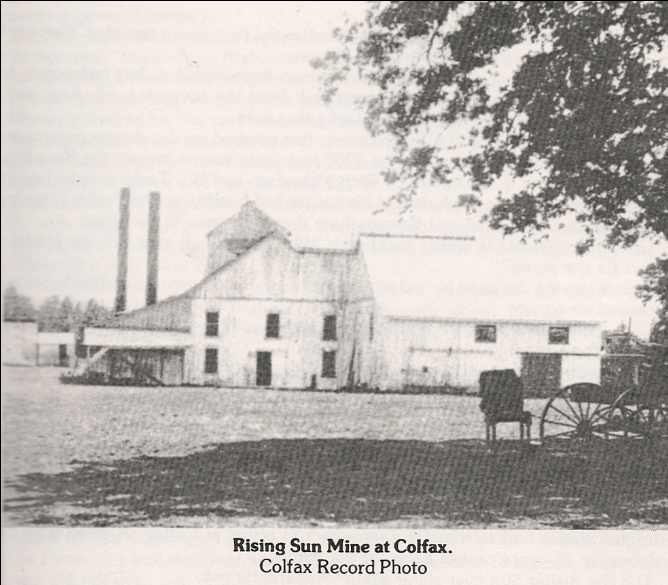
Rising Sun Mine is a mile and a half west of Colfax. It was opened in 1866 and was operated for eight years with a 5-stamp mill, and from then until about 1884 with 10 stamps. The latter mill had a daily capacity of only 20 tons. In spite of this limited capacity, the mine was reported to have yielded over $2,000,000, which, if correct, would make it the leading gold-quartz producer of the county. In 1869, when it was 230 ft. deep, the average yield was given as $25 a ton. In 1875, when a depth of 520 ft. had been reached, the average width of ore was 15 inches, and the average yield was $21.50 a ton. The total production to July 1, 1875, was about $405,000. Unfortunately, no public record remains of operations from then until the closing about 1884. The mine lay idle thereafter until 1919, when a stock company erected a modern 10-stamp mill and unwatered the mine. They reported milling less than 1000 tons before quitting. Again in 1925, the same promoter, with a company called California Premier Mines Company, reported milling about 1000 tons of good ore. Considerable dead work was done to complete a drain adit from the Bear River slope connecting with the workings about 30 ft. above the 600-ft. level, and the plant was improved. The same interests did some work on the adjacent Big Oak Tree Mine, and in 1931, were succeeded by Paramount Gold Mines Corporation. This company made some production in 1931 and 1932, working in both mines, and some of this output in the latter year was credited to the Rising Sun.
The vein is said to have averaged 18 inches wide in the upper levels and lies between hard diabase walls. It strikes northeast and dips 85° south to the 7th level, where it reverses its dip. Below this ‘roll,’ the vein widened to 4 ft. or more, and became softer. The oldest shaft, from which the early production came, was sunk to the fifth level, and another to the third level. A later and deeper one was sunk northeast of these, to 749 ft. on the dip of vein. West of it, according to the late James Richards, a former superintendent, was a pay chimney about 40 ft. long, so rich in free gold near a cross-fault that “the gold literally held the quartz together.” This fault apparently bounded the rich ore on this side and possibly had influenced its deposition. East of this shaft, pay was in stringers. On the west, it paid well to a depth of 700 ft. where the ‘roll’ in the vein occurred.
Of the last ore milled, and credited to this mine, sulphides formed about 1.7%, and yielded 2 oz. gold per ton. The promoter, however, was interested in several mines in different parts of the county, from which lots of ore may have been milled in this plant; so individual figures can not be safely given.
Cal. Journal of Mines & Geol., Vol. 32
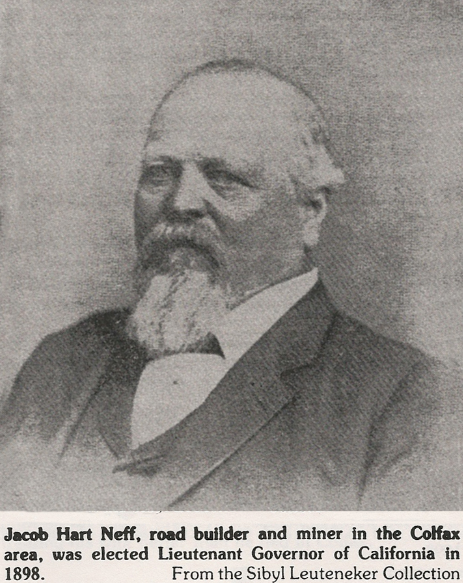
Jacob Hart Neff
Superintendent of the Rising Sun Mine around 1875
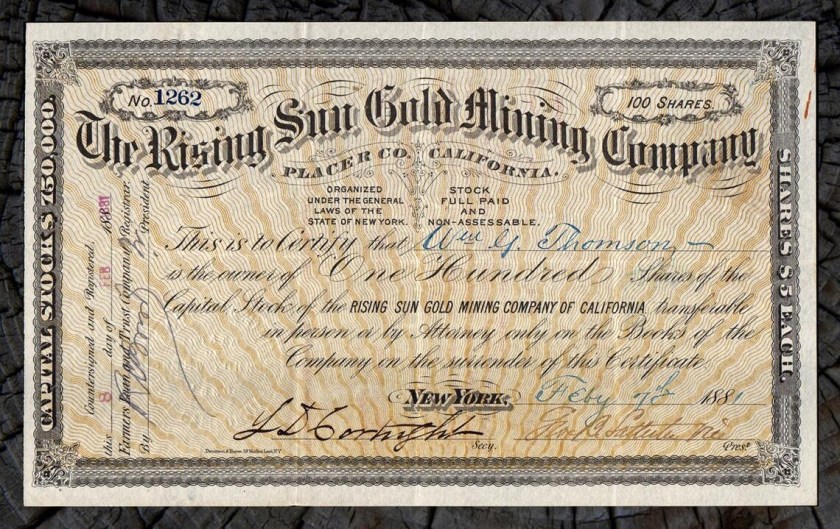
 Colfax Area Historical Society (CAHS) and Colfax Heritage Museum (CHM)