This article appeared in the May-June 2026 issue of the Colfax Cobblestones newsletter.
By Robin Yonash
A writer signing himself XXX in the November 24, 1855, issue of the Iowa Hill News started a furor by proposing to divide Placer County, with Iowa Hill as the county seat of the new county. At the time, Placer had only been in existence since April 25, 1851—less than four years—formed from portions of Sutter and Yuba Counties with Auburn as the county seat.
The Iowa Hill News, owned by Olmstead and Miller, began publication in September 1855. Sadly, no copies remain, so the contents were extracted from quotes in other papers, mostly the Placer Herald.
“A Heavy Argument in favor of Division.—We will have a county seat nearer to us some day and then we will not be dependent upon the Auburn papers for the reports of the county officers,” XXX asserted.
This was not the first time for the proposal. The previous March, the Chico Weekly Chronicle-Record reported, “A Petition is in circulation in Placer county praying the Legislature to divide it into two counties,” but apparently it did not catch the public’s eye the way that XXX’s proposal did—possibly due to his hubris in naming Iowa Hill as the new county seat.
On the surface, the argument appears to have been based on the distance to travel to Auburn from the “Divide,” as the article went on to say, “The subject of a division of the county and the want of a new county seat of reasonable convenient access to a large portion of the people of Placer County, is exciting some attention among those who are most inconvenienced by the present arrangement.”
“Yankee Jims” scathingly responded on December 6th, claiming that a “certain Senator” (nameless) obtained his “unmerited” nomination from the Know Nothing party by pledging support for the division. He went on to say, “This present arrangement, I suppose, must inconvenience the proprietors of the News, to the extent of certain official patronage, which they snuff in the distance.”
He next countered with, “We now live in a county of some importance, some weight politically, say about the fourth in political magnitude in the State; as we now stand we can make ourselves felt in our legislative bodies, but divide us up, as three X’s propose, and we shall have two counties perhaps three, (for God knows where these things will stop once commenced), neither of which will support itself, or have the necessary weight in legislative matters.
In a December 8th editorial, Tabb Mitchell, Editor of the Placer Herald, also rebuffed the division proposal, saying “…the records show that the lower portion of the county pays two-thirds of all the money that goes into the County Treasury, and that two-thirds of the expenses of the criminal calendar, taking it for the last three years, has originated on the Divide,—they will oppose the measure, knowing full well as they do, that there is more security for them in the future, by remaining as they are, than trying the uncertainties of a petty county, assuming a heavy debt to start with, not a dollar in the treasury, nor public buildings of any kind—all of which would have to be built at a heavy expense, and for which still heavier taxes would have to be levied, and as a matter of course, the taxpayers to pay them.
At the time, the “Divide” was defined to include the towns of Iowa Hill, Yankee Jims, Michigan Bluff(s), Wisconsin Hill, Humbug, Todds Valley, Foresthill, and Last Chance.
Humbug, renamed Damascus in 1856, was located about 10 miles northeast of Iowa Hill on Humbug Canyon.
Last Chance was 7.5 miles northeast of Michigan Bluff.
Both Humbug and Last Chance are now ghost towns.
On December 15th, A.B.C. wrote in support of both counter-arguments. He also rejected the idea of easier access, saying, “It is just as convenient for us to go to Auburn as it would be to Iowa Hill. The present county seat is favorably situated in a central position for the whole county, and when occasion requires our attendance at it in the winter, we don’t have two or three feet of snow to contend with, as the case is at Iowa Hill.”
That same day, “Michigan Bluffs” argued that the legislative influence of the mining districts depends “very much upon the strength and unity” with the agricultural and the commercial delegations of the western part of the county.
Subsequent writers, one mockingly designating himself as “One X,” emphasized the costs of setting up a new county, and the ensuing burden on the taxpayers.
(The concern about how to pay the county debt was a valid one. On January 14, 1856, Senator Hawthorne introduced a bill in the State Legislature to fund the debt of Placer County. Instead, on March 11, 1856, the legislature passed a bill that allowed Placer County to impose a special tax to pay down its debt.)
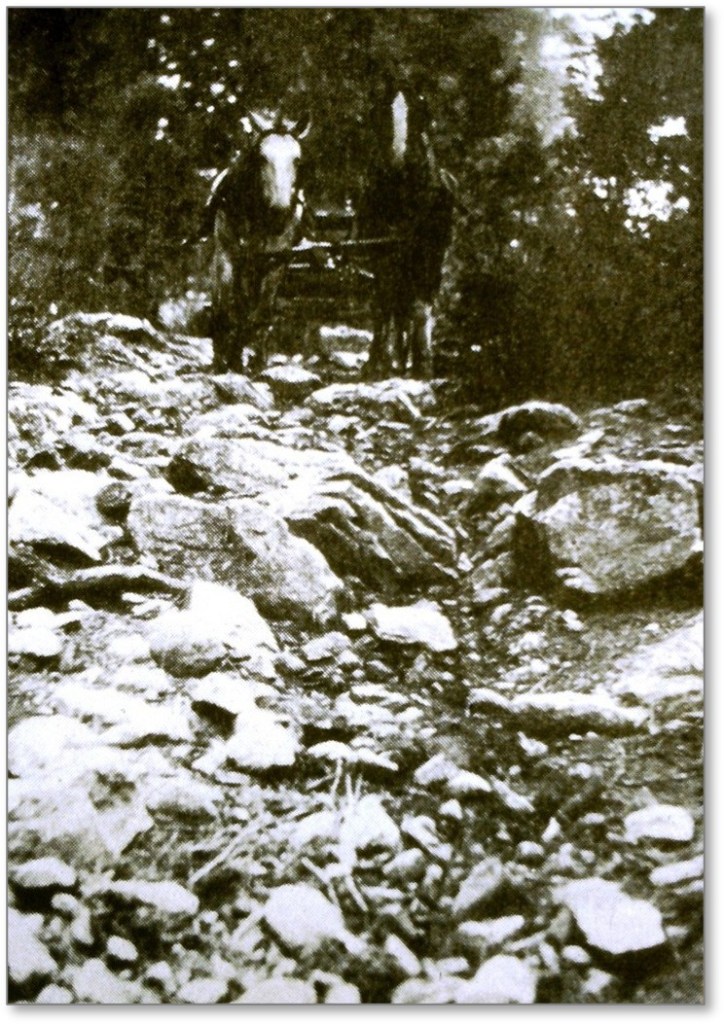
Strangely, the issue of transportation access to Iowa Hill vs Auburn was mostly not emphasized in the counter-arguments, even though that was the main reason put forth for the division in the first place. Iowa Hill was at least – if not more – as difficult to travel to as Auburn, especially during the winter. The photo on the next page shows the “road” across Shirttail Creek, which would have to be crossed to get from Yankee Jims to Iowa Hill, and this was in 1910 – 55 years later!
Another curiosity is that there was very little commentary authored by residents of south Placer.
Action began with a notice signed “Many Citizens” in the Iowa Hill News calling for a public meeting of the residents of the upper end of the county to be held at Herrick’s Hotel in Yankee Jims on the 29th of December, 1855, “for the purpose of devising measures to secure a division of the county, if that end should be deemed advisable.”
Samuel Todd, who was favorable to the division, was chosen as chairman and a committee was appointed to draft resolutions to be submitted to the meeting for action.
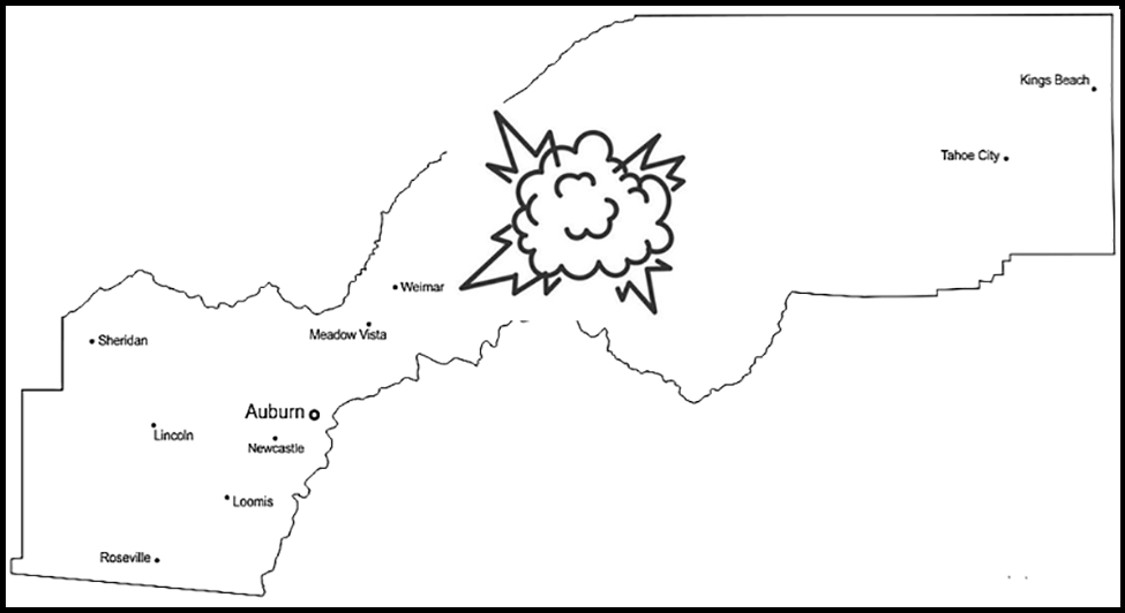
Then the meeting became fractious. During the absence of the committee, a gentleman from Iowa Hill moved for an adjournment, which passed after some discussion. The Placer Herald reported that “The gentlemen of the committee returning, found the body which had empowered them to draft resolutions, &c., and to which they were ready to report, dissolved. The explosion (of words) which took place at this juncture I will not attempt minutely to describe…”
The delegates said that they had come to discuss “not so much the expediency, for that they considered settled, of a division of the county, as where the dividing line should be.” Col. McClure replied that he was opposed to any division of the county at the present time, and that this meeting had been surreptitiously called to “make it appear that the citizens of Yankee Jims were favorable to a division, when in fact they were opposed to such a measure.”
William Duck, Esq., proposed to change the discussion to the expediency of a division, which was agreed to. Col. Wm. McClure proposed a resolution, that a Convention of the citizens of the Divide be held on January 12th at Wisconsin Hill, and that delegates be chosen for every election precinct in proportion to the number of votes polled at the last general election. This resolution was unanimously adopted.
The delegates duly met on January 12th in Wisconsin Hill: Iowa Hill 9 votes. Wisconsin [Hill] 3, Yankee Jims 4, Todd Valley 3, Foresthill 2, Smith’s Ranch 1, Mineral Bar 1, Ford’s Bar 2, Green Valley 2; total 27. Thos. P. Slade, Esq., was appointed Chairman, and M. M. Robinson, Secretary.
The motion to divide the County won by 17 to 10 and a committee was appointed to settle the boundary line of said county.
The Chico Weekly Chronicle-Record duly reported that “Interested parties are agitating the erection of three new counties by the Legislature. …; another is to be formed of the upper portions of Placer, …”
On February 25, 1856, a writer signing himself as Washington County. (Defunct.) wrote, “To show you how near we have come to a division of Placer county, I will say that each and all of the above named places [on the Divide] will vote for a division if they can have the new county line run in such a manner as to have the center of said county concentrate at their own locality; to accomplish which, beats the oldest man in the mountains.”
The last mention found in the press was by the Chico Weekly Chronicle-Record on March 10, 1855: “A Petition is in circulation in Placer county praying the Legislature to divide it into two counties.” Apparently, not enough signatures were acquired and the proposal died.
Thank goodness it did, because between 1899 and 1910, gold production in Placer County showed a precipitous decline, from about $1,000,000 annually to around a quarter of that. No definitive reason could be found for why so many mines closed, but because they did, the new county—had it happened—would have no doubt been pleading to rejoin its other half.
Author’s note: this article is an expansion of the topic mentioned briefly in my book The Iowa Hill Divide Volume 3—Gold and Fire: A History of the Iowa Hill Divide. It and my other two books, The Iowa Hill Divide Volume 1: Schools of the Iowa Hill Divide, 2nd Ed. and The Iowa Hill Divide Volume 2: Towns and People of the Iowa Hill Divide are available for purchase at the Colfax Heritage Museum. Proceeds support the Colfax Area Historical Society.
 Colfax Area Historical Society (CAHS) and Colfax Heritage Museum (CHM)